
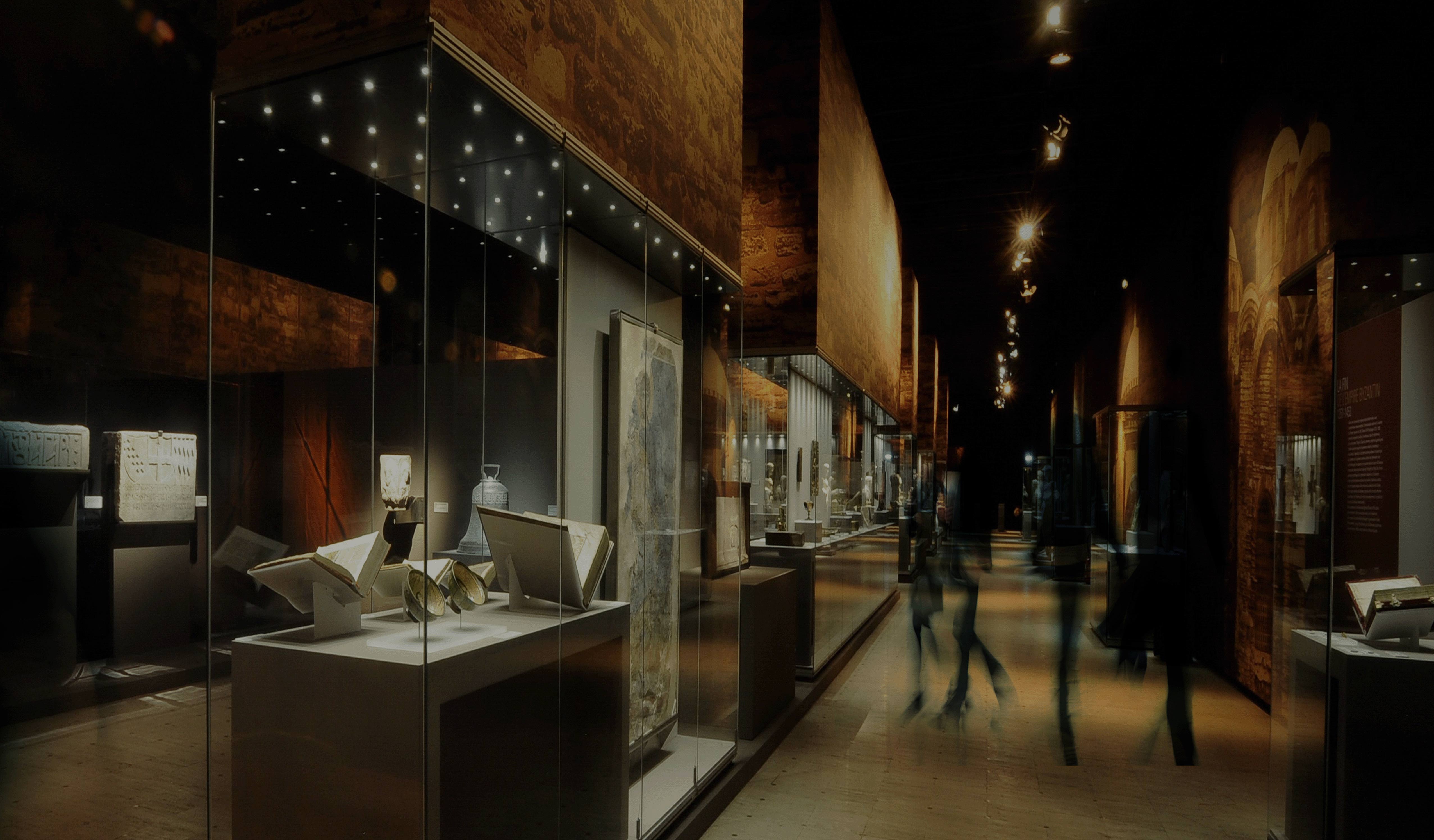
Zayed National Museum
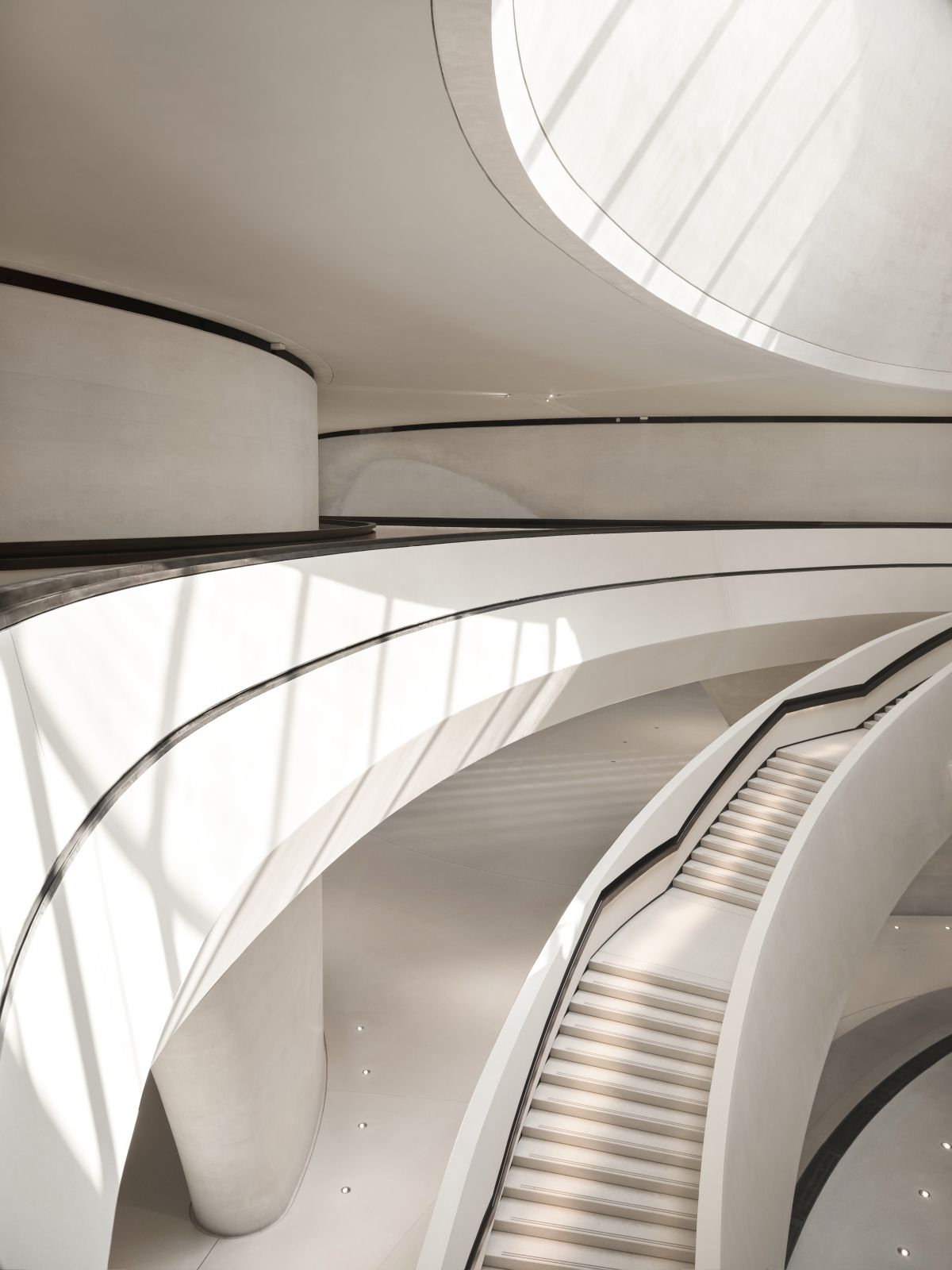
The Zayed National Museum is the flagship museum project dedicated to the history, identity and legacy of the founder of the United Arab Emirates, Sheikh Zayed bin Sultan Al Nahyan. Through an exhibition journey that connects landscape, culture and collective memory, the museum offers a contemporary interpretation of the symbols that have defined the country’s origins and evolution.
ACCIONA Cultura has participated in the technical development, manufacture and installation of bespoke museographic elements in two key galleries of the museum, dedicated respectively to the figure of Sheikh Zayed and the region’s natural environment. The scope of the work has encompassed the planning, coordination and execution of complex museographic solutions, integrating engineering, specialised production and audiovisual technologies, each of which represents innovative and highly complex exhibition solutions.
Scope of the project:
- Technical design, manufacture and installation of large-scale suspended sculptures.
- Production of monumental pieces in stone, steel and bronze.
- Development of display cases with no visible structure and special exhibition solutions.
- Integration of technical lighting systems and immersive projection.
- Restoration, adaptation and museographic integration of historical objects of high heritage value.
Client
Six Construct – Trojan Joint Venture / Department of Culture and Tourism (DCT) Abu Dhabi
Year
2025
Area of specialization
Museums
Theme
National & Civic Identity, Heritage & Archaeology, Interactive & Multimedia Experiences
Location
Asia
Surface
-
Scope
Creative concept, Design, Experience production, Art direction, Project development, Technical direction, Technical development, Graphic design, Interactive technology, Audiovisual integration, Museographic implementation, Fabrication, Installation, Vendor management
Centuries ago, the Bedouin navigated the vast expanses of the Arabian dunes guided by the flight of a loyal ally: the falcon. Through falconry, they captured small prey that allowed them to survive extreme climatic conditions. It was a vital alliance between man and nature for those nomads whom His Highness Sheikh Zayed bin Sultan Al Nahyan persuaded in the mid-20th century to form a new nation: the United Arab Emirates (UAE). As the “First Falconer,” he insisted on bringing civilisation to the Bedouin, rather than the other way around.
Part of this mission—to reclaim a nation’s historical legacy and provide the physical and institutional infrastructure of a modern state that recognised the dignity of its people—involved launching the region’s first museum, the Al Ain Museum. It opened in 1971, the year of the UAE’s official founding. His Highness Sheikh Zayed was convinced that a nation without a past is a nation without a present or a future.
Because His Highness Sheikh Zayed was convinced that a nation without a past is a nation without a present or a future.
Fifty-four years later, a building evocative of a falcon’s wing reminds us of the founder and the origins of his people. This is the Zayed National Museum, where we have spent recent years developing the exhibition experience.
Exploring three hundred thousand years of human occupation in the region, the museum turned to the expertise and vision of ACCIONA Cultura to give form to key elements of its collection.
Our work has been to push the boundaries of engineering: making the Sheikh’s horses gallop through the air; creating a steel and bronze tree to remind us of the resilience of desert flora; and restoring an original Chrysler Newport to take us back to the journey
where the leader united the Bedouin and their faithful falcons. In this feature article, we explore what happens when technical prowess meets cultural vision.
The two galleries in which we worked encompass, respectively, the history of the Sheikh and the region’s natural environment. In the first of these, we are met by the solitary figure of the Sheikh in the heart of the desert. The solemnity of the Founding Father demanded the use of techniques and materials that both respected and elevated his image.
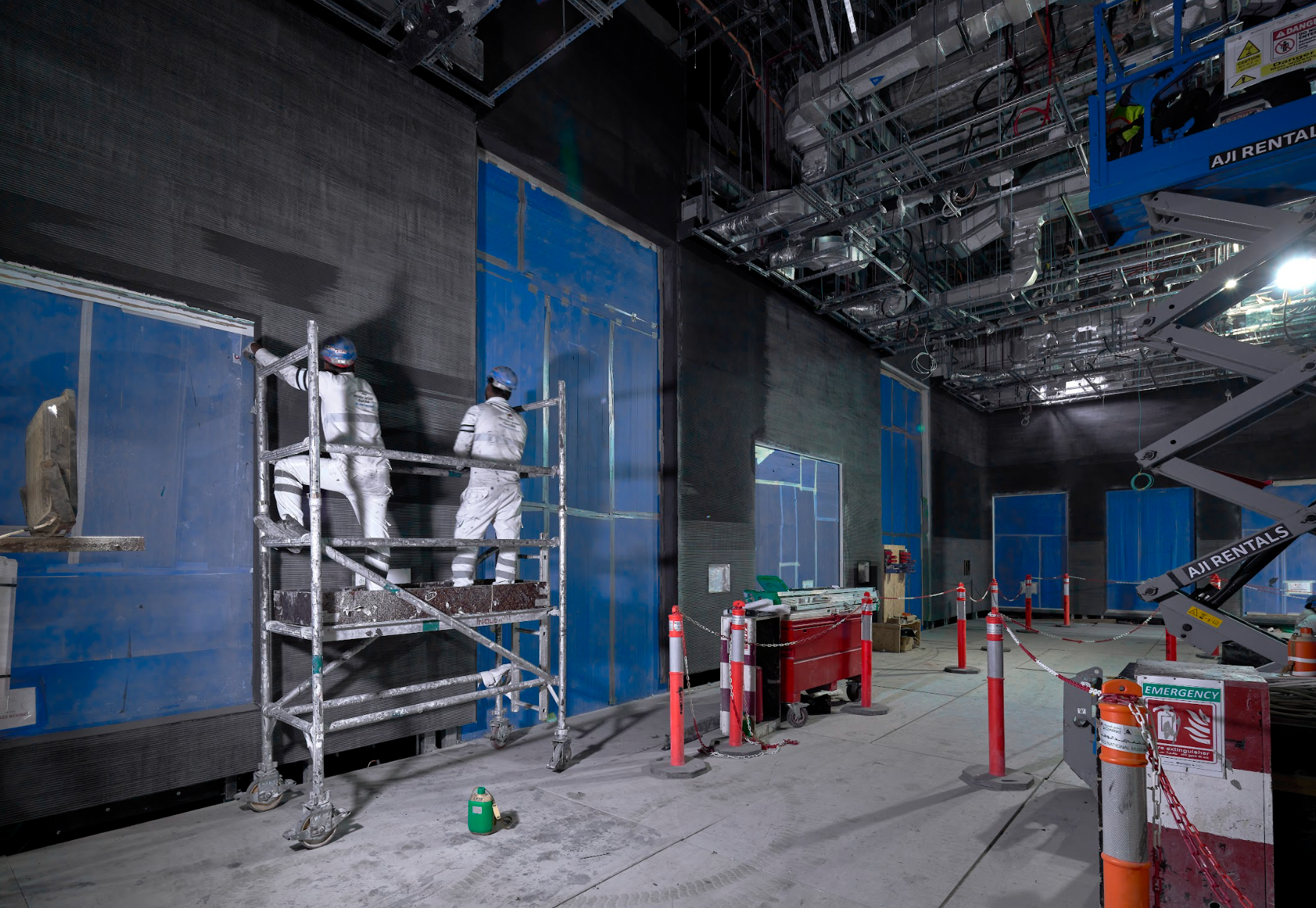
His presence, appearing almost three-dimensional, is the result of a pioneering engraving process on a Corian stone panel, carved at varying depths to achieve ninety-two distinct tonal variations. This intervention is a world-first, not only due to the scale of the 2.4-metre-high seamless panel but, more importantly, for its ability to tangibly embody the vision and spirit of a founding leader.
From galloping horses to desert trees: the challenge of bringing a country’s symbols to life.
While the falcon’s wings define the museum’s silhouette, the interior is presided over by another potent symbol: the Arabian horse. The mission was to breathe life back into Ratman and Segoria, the Sheikh’s most cherished horses.
To achieve this, we located the descendants of these two noble Arabians, using 3D scans to generate high-fidelity digital models.
From these moulds, 700kg replicas were fabricated in trabadillo, a traditional mineral composite evocative of marble. These were then hoisted to capture the majestic gallop of the animal that has been the Bedouin’s constant companion in the desert.
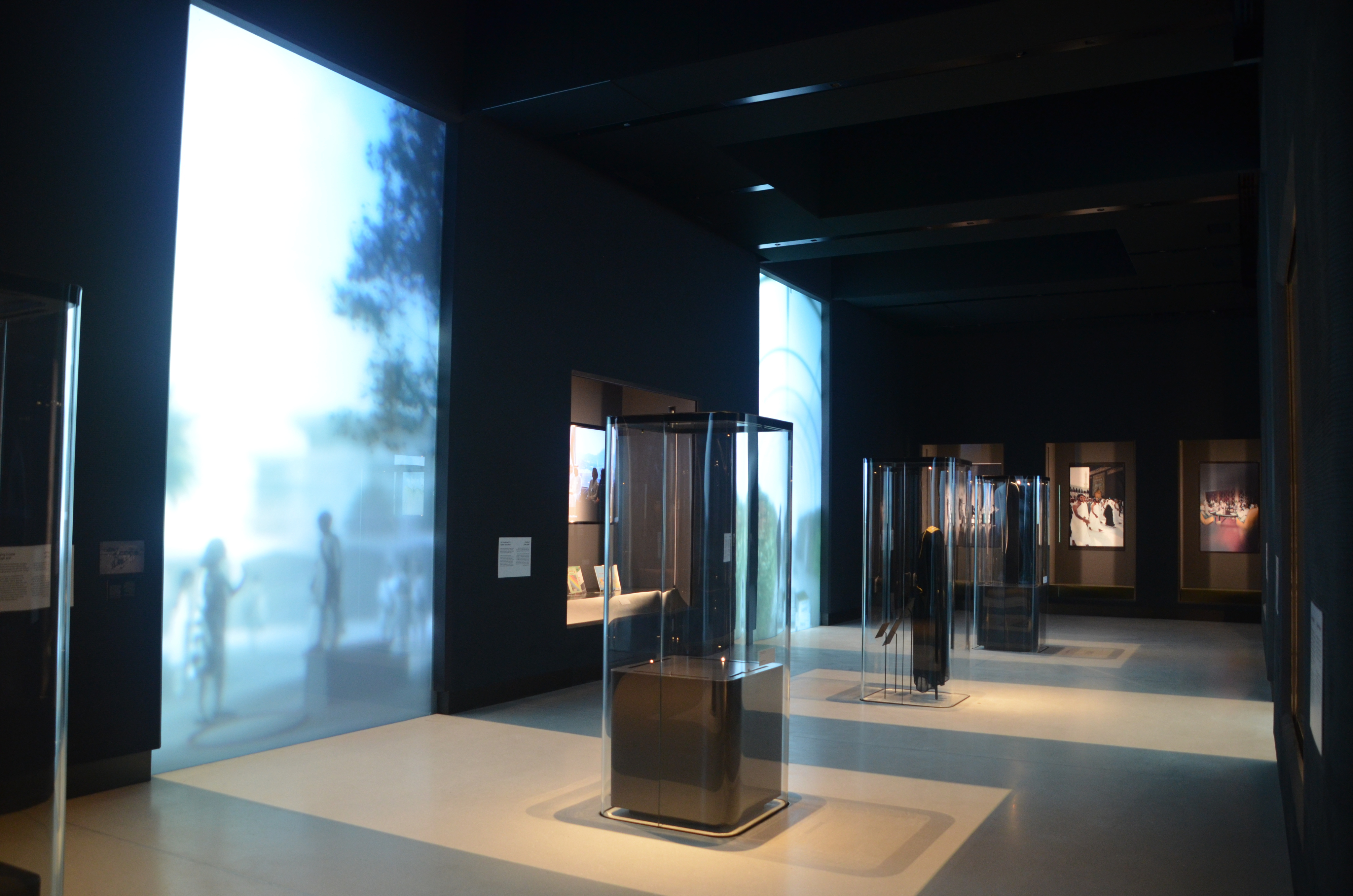
This sense of weightlessness is further enhanced by the installation of frameless glass showcases that appear to float in mid-air.
Despite his deep affection for the Arabian horse, the Sheikh also embraced modernity during his foundational journey across the Arabian Peninsula, choosing a Chrysler Newport as his mode of transport. At ACCIONA Cultura, we undertook the meticulous task of sourcing an identical model—a search that led us to California.
We then engaged vintage car specialists to restore it to its original condition, honouring the Sheikh’s actual vehicle. This went beyond a mere display: we ensured the car was mechanically sound so that its engine remains ready to start at any moment.
In the desert, the stars paint the celestial vault in all their splendour, guiding the traveller. Concluding the section honouring the Sheikh, a recreation of the sky captures the celestial alignment that presided over the leader’s final night.
Titled Sterling Night, a ceiling featuring thousands of precision-perforated apertures filters light from projectors to faithfully replicate the stars on that occasion. A haze machine renders each beam of light visible, lending the space an intimate, reflective atmosphere that balances the vastness of the sky with human finitude.
.png)
.png)
.png)
In the UAE, the sky offers barely one hundred litres of rain per square metre annually—less than a tenth of the rainfall seen in countries like the United Kingdom. Yet, the parched desert expanses traversed by the Bedouin reveal profound resilience. Such is the case of the ghaf, a tree with medicinal qualities that also sustains desert wildlife.
ACCIONA Cultura, we sought a tree that would symbolise the essence of this species—a “Platonic” ideal. Following a journey through the dunes, we returned with a feature article’s worth of photography documenting dozens of specimens. The chosen tree was translated into a 3-D model and cast in bronze.
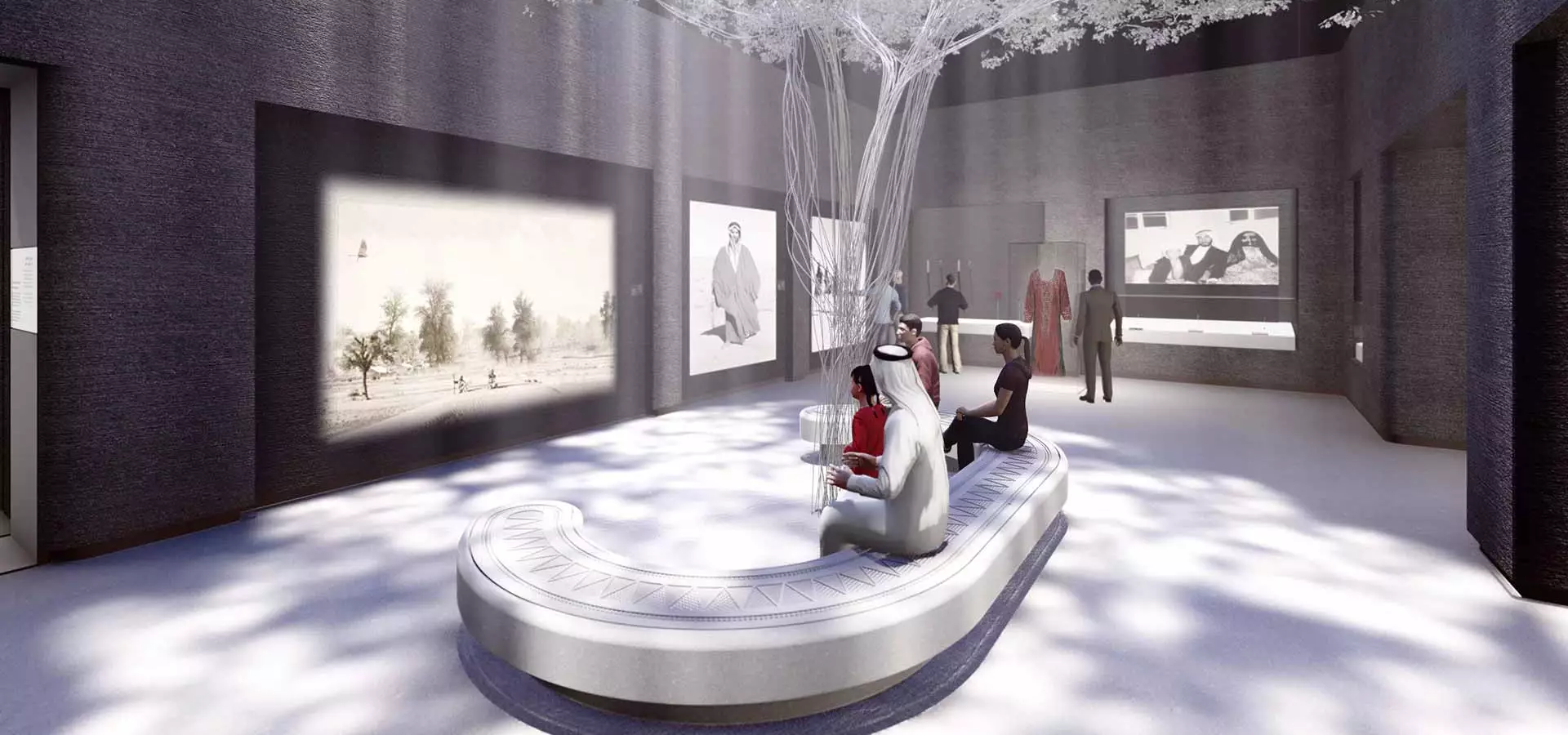
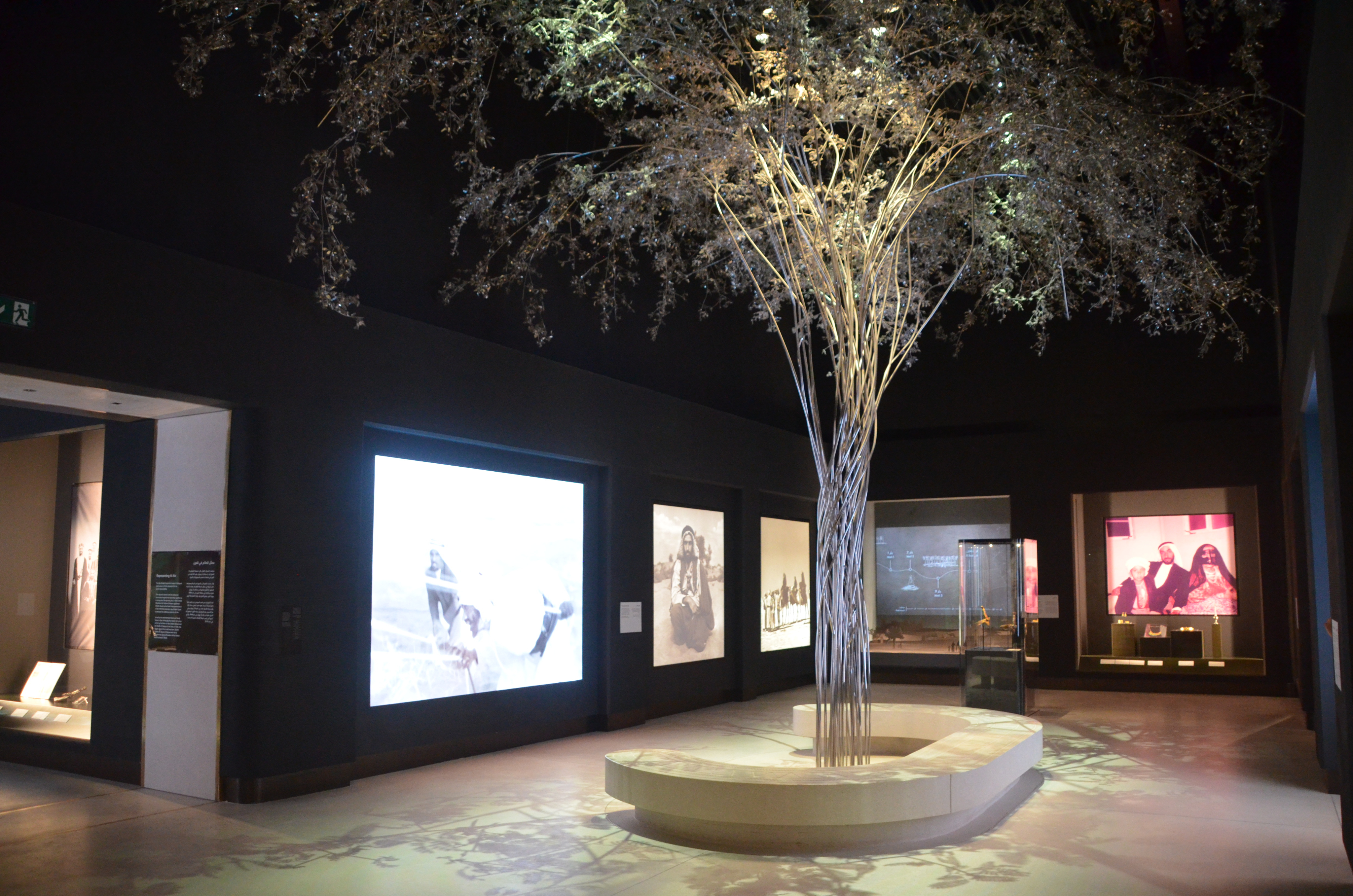
The space also hosts a poetic abstraction of the flora that thrives in such hostile conditions: a seven-metre-high stainless steel installation brought to life with tens of thousands of laser-cut leaves, connected to its branches via delicate metallic filaments.
The result is an ode to nature that takes centre stage within the gallery.
.png)
.png)
.png)
.png)
Upon exiting the gallery exploring the natural environment, a large-format alabaster piece greets the visitor, who by now has become a traveller. This relief captures the topography of the UAE through an overhead projection, offering a physical representation of the country from a falcon’s-eye view. This serves as a way to connect with the landscape and identity of the Emirates.
In each gallery, we developed a projection design ranging from superimposed imagery on the curved walls of the Sheikh’s horse room to monumental video walls at the journey’s end.
These technical solutions enhance the storytelling, bringing the narrative closer to the visitors.
How is a country’s identity defined? What is it that unites us? These are undoubtedly questions the founder of the UAE explored during his primordial journey through the desert. His answers are found in the nation today, in the galleries of that first Al Ain Museum, and in this new space built in his honour.
Our museum work—which is also reflected in the new museum in Oman—is a narrative of light and matter about who we are, as citizens of a nation and as a species on this planet.
From the project’s inception to its inauguration at the end of 2025, we have challenged the boundaries of engineering to create a physical manifestation of those dreams and that history: a vehicle for connection and transcendence.
.png)
.png)
.png)
.png)
.png)
A welcome in relief
Sheikh Zayed extends his hospitality through this large-scale piece, which features his portrait in the form of a carved, backlit relief.
No results found.